
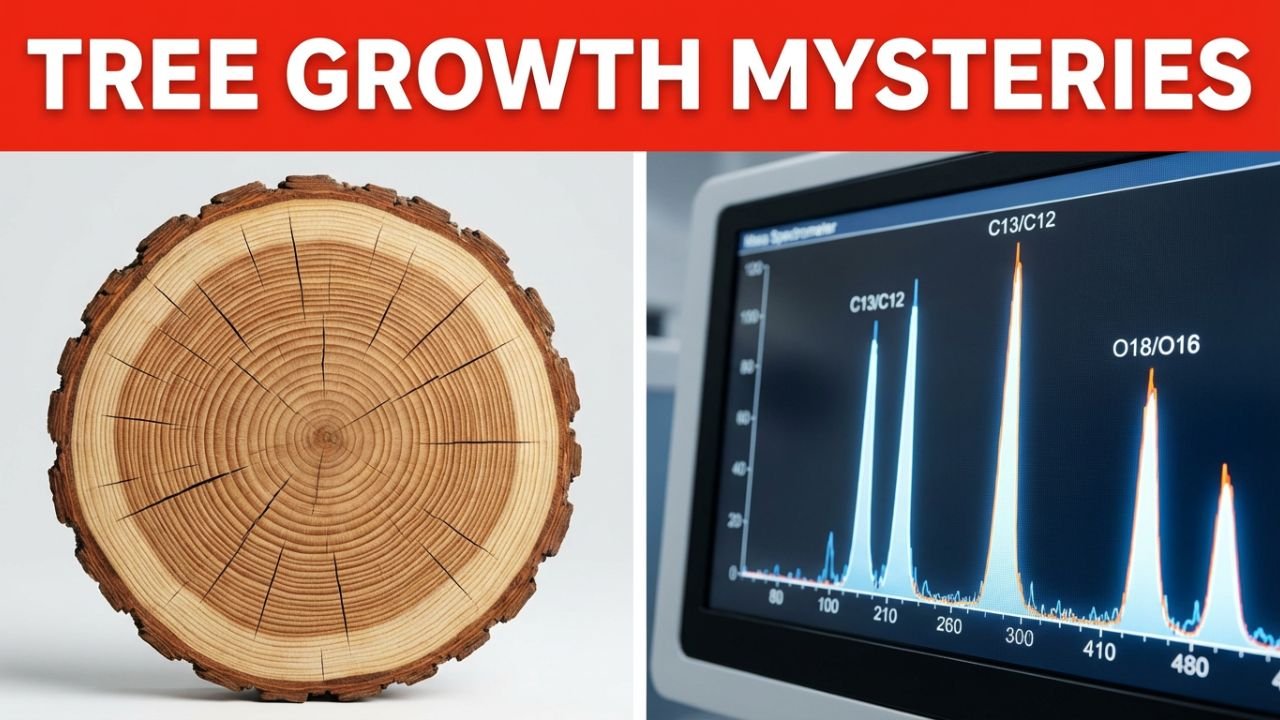
Isotope Labeling in Wood Formation Studies: The illegal timber trade is not only an environmental problem but also a social, economic, and legal crisis worldwide. This problem is particularly severe in tropical regions, where forests are a treasure trove of biodiversity and millions of people depend on them for their livelihoods. Illegal logging not only destroys wildlife habitats but also impacts the income of local communities, government revenue, and legitimate trade. In regions like the Congo Basin in Central Africa, a significant portion of the timber exported from some countries is believed to have been illegally harvested. The problem is that law enforcement agencies often lack the scientific tools to verify the true country or region of origin of the timber. This is where the need for “origin verification” arises.
A Unique Method for Wood Identification: Stable Isotope Ratios
In recent years, scientists have adopted a highly interesting and effective technique – the use of stable isotope ratios. Every region has unique soil composition, rainfall patterns, temperature, distance from the sea, and geological structure. These natural factors influence the elements absorbed by trees, and these elements leave a kind of “chemical fingerprint” in the wood. The main isotopes used are:
- δ18O (Oxygen)
- δ2H (Hydrogen)
- δ13C (Carbon)
- δ34S (Sulfur)
These ratios are compared to a reference database, allowing researchers to estimate the region of origin of the sample. This principle has previously been successfully used to identify the origin of narcotics, ivory, coffee, and food products. However, its application to tropical timber is still limited, and the results have been mixed.
Why is geographical variation important?
For any origin verification method to be successful, it is essential that the wood from different regions exhibits clear differences in isotopic ratios. This difference depends on several factors—such as the amount and isotopic composition of rainfall, temperature, altitude, distance from the sea, soil composition, and sources of nitrogen or sulfur. For example, areas near the sea may have different sulfur (δ34S) ratios, while oxygen and hydrogen isotopes vary in high-altitude regions. This natural variability gives the wood a region-specific identity.
Why this study focusing on Central Africa is special
This study aimed to understand the isotopic variability in timber from Central Africa to test how accurately this technique can determine the true origin of the wood. Researchers collected samples from 17 different sites in three major timber-exporting countries of the Congo Basin—Cameroon, Gabon, and the Republic of Congo. These regions are considered vulnerable to illegal timber trade, making scientific transparency here crucial.
This research included two important timber species:
- Azobé (Lophira alata)
- Tali (Erythrophleum species)
Both are highly valued in the international market.
Sample collection and laboratory analysis
Scientists collected heartwood samples from 20–30 trees at each site. A variety of tree sizes were included to minimize the effect of age. The samples included wood formed over several years, providing a more stable isotopic signal. The isotopic ratios were then measured in laboratories using specialized equipment (IRMS – Isotope Ratio Mass Spectrometry). All results were expressed according to international standards.
New Technology: Machine Learning and “Isoscapes”
This study utilized not only measurement but also machine learning. Scientists created isotopic maps (Isoscapes) of the entire region using an advanced statistical method called “Quantile Regression Forests.” These maps show the potential isotopic signature of wood in a given area. The advantage of this method is that it can handle complex and unusual data patterns and also provides information about the uncertainty of the predictions.
Key Results: Is Wood Identification Possible?
The study analyzed samples from 288 trees. Differences were found in all four isotopes based on species and location. For example:
- δ18O values ranged from approximately 24.7 to 30.9‰
- δ2H from −25.8 to 36.6‰
- δ13C from −31.1 to −21.9‰
- δ34S from 4.4 to 10.9‰
Some important findings:
- The accuracy of wood identification at the country level reached 60–80%.
- Accuracy at the site level was lower, approximately 18–32%.
- δ34S and δ18O proved to be the most useful indicators.
- Clear differences were also found between the two species.
This suggests that verification is possible at the country level, but more data is needed at the local level.
The Role of This Research in Combating Illegal Trade
This research demonstrates that science can now play a significant role in increasing transparency in the timber trade. If large-scale isotopic databases are created, this could revolutionize the fight against illegal logging and timber trafficking.So, customs agencies and forestry departments can test suspicious wood samples. This can help curb trade conducted with the help of fraudulent documents.
Conclusion: The Intersection of Science and Conservation
Stable isotope technology is not magic, but it is a powerful tool that provides a scientific basis for the fight against illegal timber trade. This study has shown that there is a strong possibility of tracing the origin of timber in Central Africa, especially when modern machine learning methods are incorporated. In the future, with more species, more locations, and a more comprehensive database, this technology could prove to be a major step towards global forest conservation.
Protecting forests is possible not only through laws, but also through science, transparency, and international cooperation—and this research is a strong initiative in that direction.
