
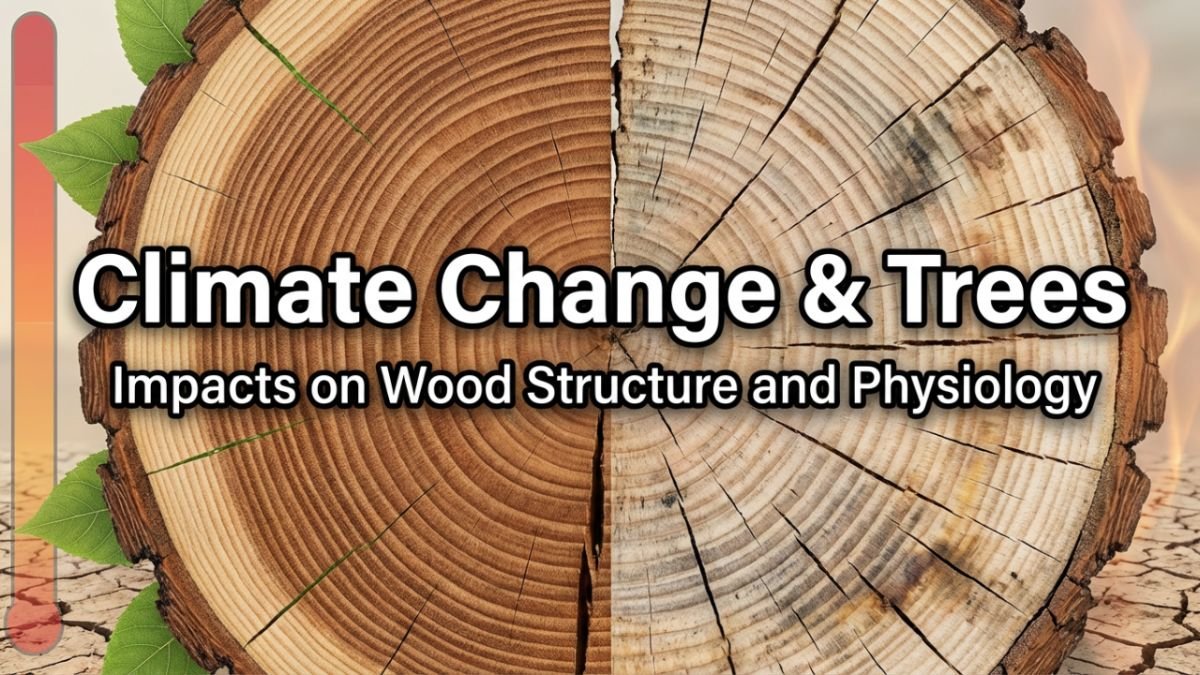
Climate change has become one of the most serious global challenges of our time, and its impact is not limited to temperature or rainfall; it is directly altering the internal structure and biophysical processes of trees. Rising temperatures, prolonged and intense droughts, irregular rainfall, and increasing atmospheric carbon dioxide levels have forced trees to constantly adapt. Trees, generally known for their long lifespans and slow adaptation capabilities, are now facing environmental pressures that are challenging the limits of their resilience. This is directly affecting wood structure, water transport systems, and overall tree physiology.
The Impact of Climate Change on Wood Structure (Dendroanatomy)
Drought and increased temperatures leave a lasting mark on the xylem structure of trees. When water availability is low, trees begin to alter the structure of their internal cells to survive. Typically, under drought conditions, the internal diameter, or lumen area, of vessels and tracheids decreases. This ensures safer water flow but reduces its efficiency. In many species, dry conditions lead to increased wood density due to a higher proportion of latewood, which has thicker cell walls. Unusual structures are also observed during periods of extreme environmental stress, such as very narrow tree rings, lighter-colored rings, or sometimes even cell collapse. Furthermore, in recent years, there has been an increase in the occurrence of “false rings” or intra-annual density fluctuations (IADFs), indicating that trees have experienced multiple periods of stress and relief within a single year.
Increasing Atmospheric CO₂ and Wood Structure
Increased concentrations of carbon dioxide in the atmosphere can, to some extent, enhance photosynthesis, leading to a temporary increase in the radial growth of trees. However, this effect is not uniform across all species. In some ring-porous species, the formation of larger vessels may increase, improving water transport but also increasing the risk of cavitation. Thus, the effect of CO₂ acts like a double-edged sword—while it aids growth, it can also compromise hydraulic safety.
The Impact of Climate Change on Tree Physiology
Trees’ physiological responses often involve a trade-off between growth, energy storage, and survival. As drought intensity increases, water tension in the xylem rises, leading to air entering the vessels, a process called cavitation. When this process becomes widespread, water transport is disrupted, potentially leading to tree death. On the other hand, to conserve water, trees close their stomata, reducing CO₂ uptake. This decreases photosynthesis and carbohydrate storage, a condition known as carbon starvation. Some trees adopt a strategy of closing stomata early, while others keep them open longer—both approaches carry different risks.
Phenological Shifts and Seasonal Imbalances
Rising temperatures are causing spring to arrive earlier in many regions, leading to premature cambium activity. This can increase earlywood formation, but it also increases the risk of damage from late frosts, which can harm newly formed cells. Furthermore, increased temperatures affect nutrient availability in the soil, negatively impacting overall tree growth.
Varying Responses by Species and Region
The effects of climate change are not uniform across all trees. Conifers are generally more susceptible to drought, and their wood may exhibit thinner latewood layers, reducing their recovery capacity. On the other hand, the response in angiosperms is more varied—some deciduous species are highly sensitive, while some evergreen species remain relatively stable. Geographically, rising temperatures can promote growth in high-latitude or high-altitude regions, while in Mediterranean and semi-arid regions, drought limits growth and increases mortality.
Long-Term Consequences: The Future of Forest Ecosystems
If the pace of climate change continues unabated, many long-lived tree species may exceed their adaptive limits. This could lead to widespread forest dieback, particularly among species considered keystone species in their ecosystems. Furthermore, forests affected by drought and mortality can shift from being carbon sinks to carbon sources, as the decomposition of dead trees releases large amounts of CO₂ back into the atmosphere.
Conclusion
Climate change is profoundly affecting the wood structure and physiology of trees. This impact is not limited to tree growth but also affects entire forest ecosystems, biodiversity, and the global carbon cycle. Studies of dendroanatomy and tree physiology help us understand how trees are responding to a changing environment and what strategies we will need to employ to conserve forests in the future. This is why the impact of climate change on tree wood structure and physiology has become a critically important topic in environmental science today.
