
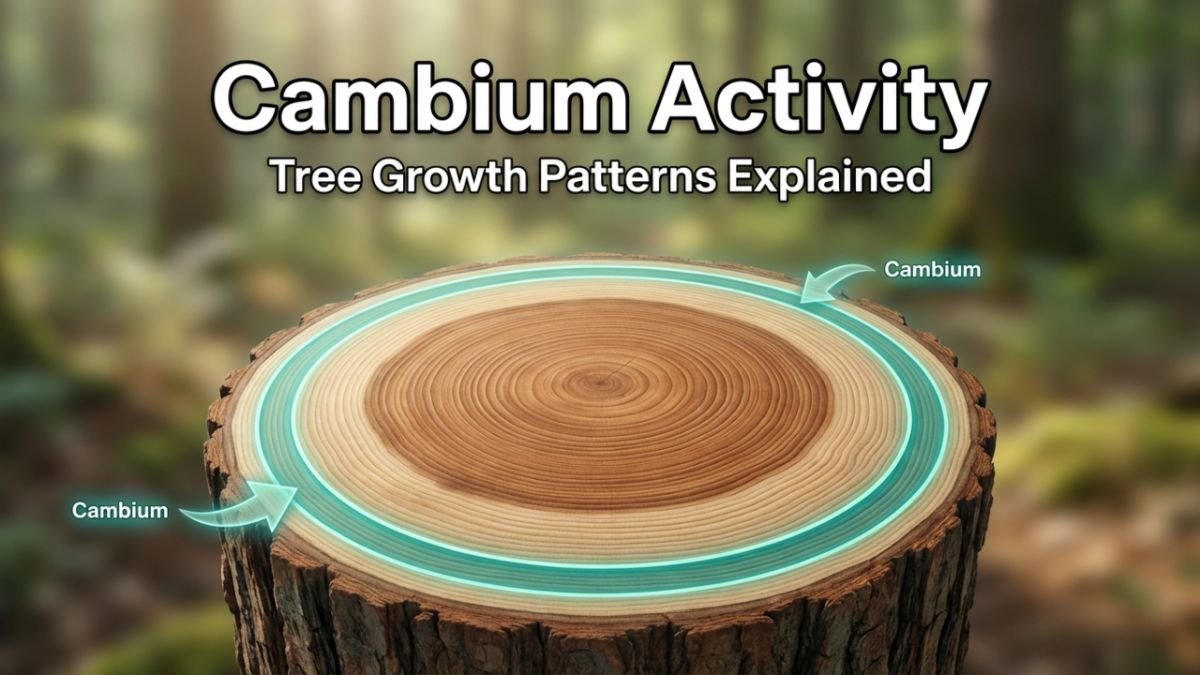
Hidden within the trunk of trees is an incredibly thin but extremely powerful layer called the vascular cambium. This layer is located between the wood (xylem) and the inner bark (phloem) and is responsible for increasing the tree’s diameter, a process known as secondary growth. The cambium can be considered the tree’s “stem cell layer,” as its cells are undifferentiated and continuously divide to produce new xylem and phloem cells. Xylem is formed towards the inside and eventually becomes wood, while phloem is formed towards the outside and assists in the transport of nutrients. This process is what causes the tree to grow thicker and stronger year after year.
Structure and Function of the Vascular Cambium
The vascular cambium is primarily composed of two types of initial cells—fusiform initials and ray initials. Fusiform cells are long and elongated and give rise to the tissues that run along the length of the stem (such as xylem and phloem). Ray initials, on the other hand, are shorter and roughly cuboidal, forming the radial tissues responsible for the horizontal transport of nutrients within the stem. A unique characteristic of the cambium is that it is bifacial, meaning it produces both wood towards the inside and bark towards the outside. Over time, xylem accumulates, while the older phloem is shed.
Cork Cambium and Bark Formation
As the tree’s diameter increases, the need for external protection also grows. This is where the cork cambium (phellogen) becomes active, forming the outer bark, or periderm, of the tree. This layer protects the tree from drying out, insects, and mechanical damage. The cells produced by the cork cambium are dead, but they provide a strong protective covering for the tree.
Seasonal Changes and Cambium Activity
Cambium activity varies according to environmental conditions. In temperate regions, this activity almost ceases in winter and resumes as temperatures rise in spring. Conversely, in tropical regions, cambium activity primarily depends on water availability. Its activity intensifies during the rainy season, while it may slow down or become inactive during the dry season. This seasonal variation is what leads to the formation of distinct annual rings in trees, which reflect their age and environmental history.
Earlywood and Latewood: The Story of Tree Rings
The varying seasonal activity of the cambium creates two distinct parts in the wood—earlywood (springwood) and latewood (summer or autumnwood). Earlywood is formed when growth is rapid, such as in spring. It consists of large cells with thin walls, allowing for more efficient water transport. Latewood, on the other hand, is formed when growth slows down; it has smaller cells with thicker walls, providing strength to the wood. The combination of these two forms the annual rings.
Environmental Factors Controlling the Cambium
Cambium activity is influenced by several external factors. Temperature plays the most significant role in temperate regions, while moisture or rainfall is the biggest factor in tropical and semi-arid regions. In addition, day length (photoperiod) also acts as a consistent signal, “informing” the tree when the growing season is beginning or ending.
Hormonal Control and Internal Signals
The cell division process of the cambium is entirely dependent on hormonal balance. Auxin, produced in young leaves and buds, flows downwards, activating the cambium. Cytokinins promote cell division, while gibberellins aid in cell expansion and growth. Furthermore, modern science has identified signaling pathways such as TDIF-TDR-WOX4, which maintain the activity of cambium stem cells for extended periods and prevent premature differentiation.
Growth Patterns in Different Trees
Cambium activity is not uniform across all trees. Ring-porous trees like oak and ash exhibit very rapid growth in the early season, forming large vessels. Diffuse-porous trees like maple and poplar produce vessels of similar size throughout the year. In coniferous trees, the xylem is primarily composed of tracheids, which perform both water transport and mechanical support functions.
Wound Healing and Cambium Regeneration
When a tree is injured, the cambium cells dedifferentiate and form callus tissue, which covers the wound. Subsequently, new cambium gradually develops, and the normal growth process resumes. This ability is what allows trees to survive and remain resilient for long periods.
Conclusion
The cambium is not merely a single layer of cells; it is the lifeline of the tree. Its activity determines the tree’s growth, strength, environmental adaptation, and longevity. By understanding the science of the cambium, we can not only gain a better understanding of the biological processes of trees but also obtain crucial information for areas such as forest management, climate studies, and carbon sequestration. This is why the science of cambium activity and tree growth patterns is considered a vital pillar of modern environmental research.
