
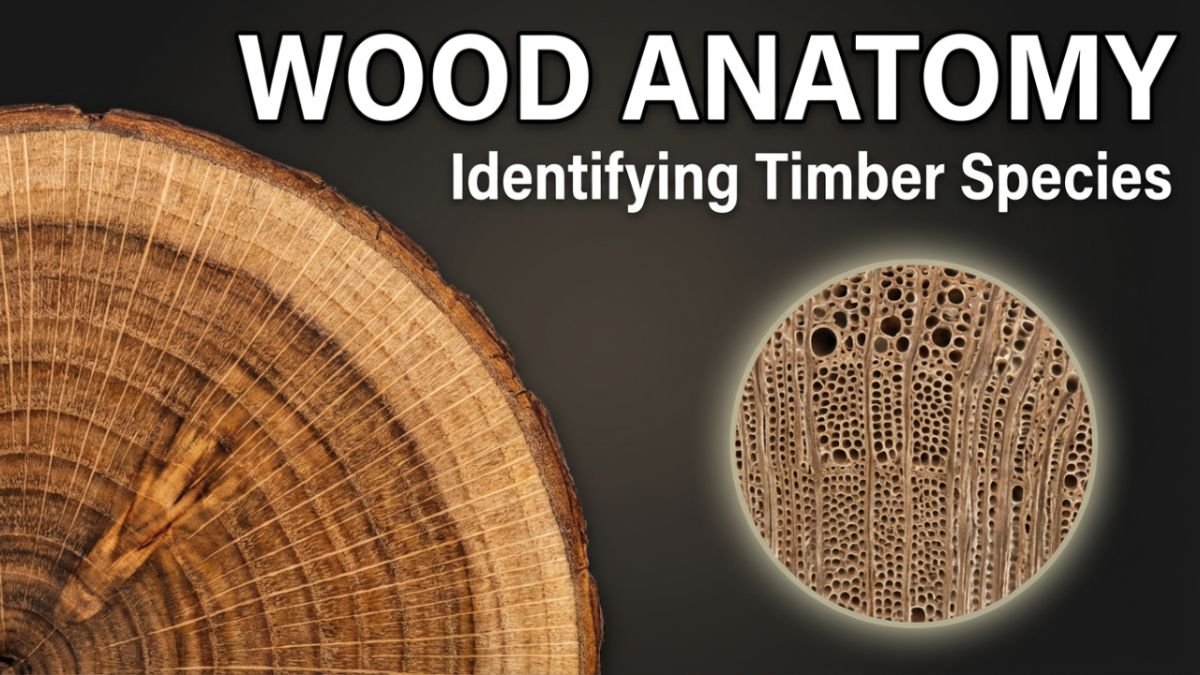
Accurate wood identification is crucial not only for forest protection and wildlife conservation but also for ensuring quality in furniture, construction, and industrial applications. Wood anatomy, the study of the microscopic structure of wood, is the most reliable method for this identification. It involves analyzing the unique patterns of wood cells—primarily vessels, parenchyma, rays, and fibers. These structures are specific to each species and provide a fingerprint-like identification. Through wood anatomy, experts or AI models can prevent illegal timber trade and accurately identify species.
Key Anatomical Features
1. Vessels (Pores)
Vessels are considered the most important element in wood identification. Their size, shape, and distribution—whether they are solitary, in groups, or forming clusters—are used to identify hardwood species.
- Ring-Porous: Large vessels in the springwood and smaller ones in the summerwood, for example, oak and ash.
- Diffuse-Porous: Vessels of uniform size throughout the year, such as maple and birch.
- Semi-Ring Porous: Vessel size gradually decreases, such as walnut and hickory.
2. Parenchyma
Parenchyma cells store food and water. Their pattern—such as banded, vasicentric, or aliform—is often species-specific and is observed in the cross-section.
3. Rays
Rays are horizontal and radial cells that appear as lines on the end-grain. Their width and length facilitate species identification. For example, oak exhibits large and prominent rays.
4. Tracheids and Resin Canals
The absence of pores in softwoods and the presence of uniform tracheids or vertical/longitudinal resin canals aid in species identification.
5. Tyloses
Tyloses are small, bubble-like growths that block the vessels. For example, white oak has tyloses, which helps distinguish it from red oak.
Methods of Analysis
1. Macroscopic Observation
Color, texture, and pore patterns are studied by examining the end-grain with a 10x lens.
2. Microscopic Analysis
Microscopic anatomical features are analyzed on thin slices using light or electron microscopy.
3. Digital Tools and AI
High-resolution imaging and deep learning algorithms are used to automatically identify end-grain patterns.
Benefits of Anatomical Identification
1. Legal Compliance
Helps prevent illegal logging and trade of protected or restricted timber species.
2. Quality Assurance
Ensures the use of the correct and specified wood species in construction, furniture, and industrial applications.
3. Scientific Research
Anatomical data contributes to biodiversity studies, functional understanding of species, and ecological research.
Conclusion
Wood anatomy is the most reliable and scientific method for accurate identification of wood species. The study of structures such as vessels, parenchyma, rays, and fibers enables experts to correctly identify species, prevent illegal trade, and contribute to biodiversity and environmental conservation. Modern digital technology and AI-based analysis have made this process faster, more accurate, and scalable. Therefore, the role of wood anatomy in wood identification is not only important but also essential.
