
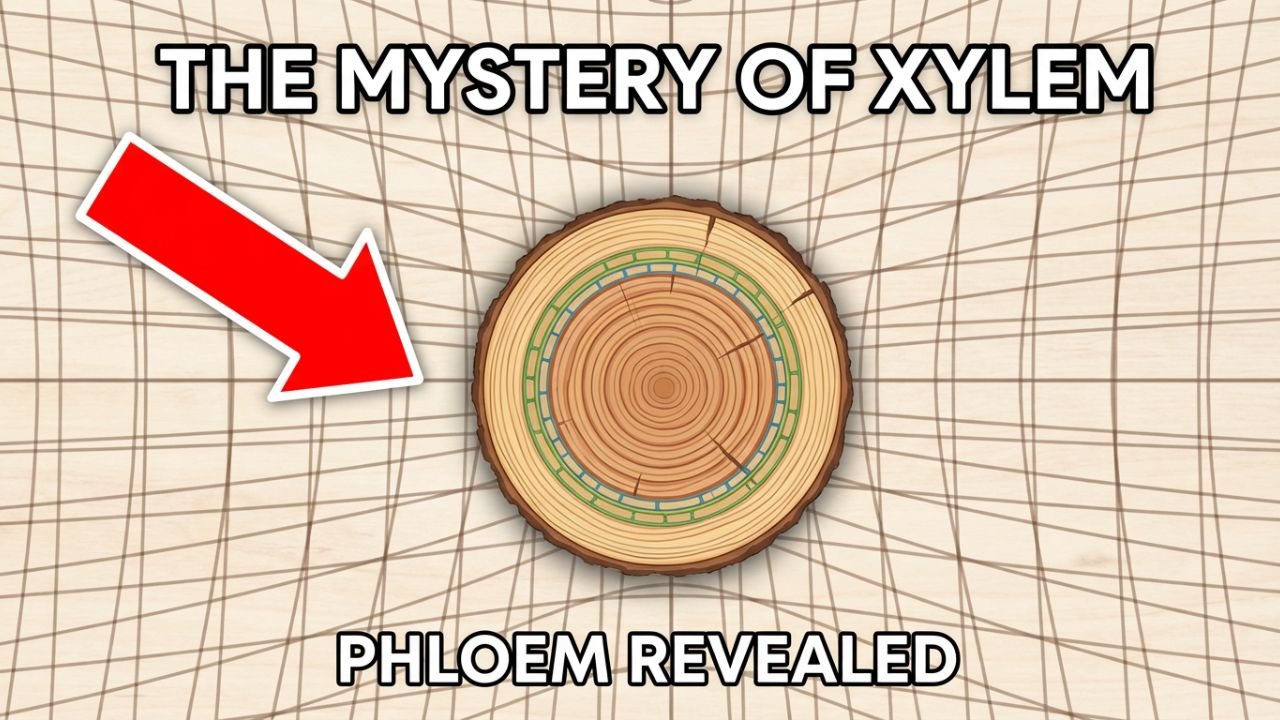
The towering trees standing on Earth don’t survive simply because of their strong trunks and green leaves; a highly complex transport system is constantly active within them. This system is called the vascular system, which transports water, nutrients, hormones, and food produced by photosynthesis from the roots to the top. This system has two main parts—phloem and xylem. The secondary part of the xylem, which we commonly call “wood,” is the main pathway for the vertical transport of water in trees.
Research has often focused on the dead conducting elements of the xylem (such as tracheids and vessel elements), as these are the primary conduits for water flow. However, the living cells present in this tissue—xylem parenchyma—have long been neglected. In recent years, there has been a growing understanding that these cells act as “active control centers” within the wood. They play several crucial roles, not only in storage but also in repair, defense, water balance, and communication between tissues.
Structure of Secondary Xylem (Wood): Not Just a Solid Framework, but a Living System
Mature xylem tissue is mainly composed of three types of cells—conducting elements (tracheids and vessel elements), fibers, and parenchyma cells. The conducting elements are dead, but their thick, lignin-rich walls enable them to withstand extremely negative pressure, allowing them to draw water to great heights.
In gymnosperms (such as cedar and pine), tracheids are the primary conducting cells, which are narrow and connected to each other through bordered pits. In angiosperms (flowering plants), vessel elements have a larger diameter and are joined end-to-end to form long tubes. Pits between them also facilitate lateral flow.
Fibers provide mechanical strength to the wood. In some cases, they may also participate in carbohydrate storage. However, the most versatile cells are the xylem parenchyma, which, despite their thin walls, remain alive and metabolically active for many years.
Sapwood and Heartwood: The Difference Between Active and Inactive Wood
The outer part of the tree trunk is called sapwood, where living cells are present and water transport continues. The inner part is heartwood, which forms with age and is generally inactive—it contains no living cells, and water flow ceases. The transformation from sapwood to heartwood occurs with the age of the tree, and the role of parenchyma cells in this process is considered crucial.
What is Xylem Parenchyma? The Living Network Within Wood
Xylem parenchyma cells are connected to each other through simple pits, which contain numerous plasmodesmata. This allows them to form a three-dimensional living network that extends in both the axial (up-down) and radial (from the center outwards) directions of the wood.
These cells act as a bridge between the xylem and phloem. It is believed that the water flow in the xylem is functionally connected to the phloem through the ray parenchyma. In this way, these cells become a vital medium for communication and resource distribution within the tree.
Types: Axial and Ray Parenchyma
Xylem parenchyma is mainly divided into two types—axial and ray parenchyma.
Axial parenchyma runs parallel to the length of the stem. It can be of two types—
- Paratracheal, which is located adjacent to the conducting elements
- Apotracheal, which is located separately from them
Apotracheal parenchyma also includes “initial” and “terminal” parenchyma, which are found at the boundaries of the annual growth rings.
Ray parenchyma is oriented in the radial direction and connects the xylem to the phloem. In gymnosperms, most living cells are found in this form.
Main Functions: Not Just Storage, but Multiple Life-Saving Roles
1. Carbohydrate Storage:
Parenchyma cells store food substances such as starch. This reserve serves as an energy source during drought, cold, or at the beginning of growth.
2. Water Storage and Balance:
These cells can store water, helping the tree maintain balance during water stress.
3. Embolism Repair:
When air bubbles (embolisms) form in the xylem and disrupt water flow, parenchyma cells release sugars and ions, creating pressure changes that can restore flow.
4. Defense Mechanism (CODIT):
In case of wounds or infections, these cells create chemical barriers to limit damage—this is related to the Compartmentalization of Decay in Trees (CODIT) principle.
5. Tissue Communication:
Parenchyma acts as a medium for the exchange of information and substances between the xylem and phloem.
Differences in Gymnosperms vs. Angiosperms
In gymnosperms (softwoods), the wood is relatively simpler—more tracheids and less parenchyma. Some species also have resin canals, whose surrounding epithelial cells produce resin for defense.
In angiosperms (hardwoods), the structure is more complex—with vessel elements, fibers, and abundant parenchyma. Here, the role of parenchyma becomes even more extensive.
Unanswered Questions: New Directions for Research
Although xylem parenchyma is now…Interest in parenchyma has increased, yet many questions remain unanswered:
- How do these cells precisely regulate embolism repair?
- How crucial is their role in the sapwood-to-heartwood transition?
- What are the molecular mechanisms of their response to environmental stress?
Answers to these questions will help us understand the climate adaptation capacity of trees.
Conclusion: The Living Cells Within the Wood Are the Real “Management Team”
Xylem parenchyma cells demonstrate that wood is not merely a dead structure, but a living, dynamic, and coordinated system. These cells maintain the balance of tree life through functions such as storage, repair, defense, and communication. Future research will unlock the secrets of these cells, leading to a new understanding of tree resilience, growth, and environmental adaptation.
